
• 2 Posts
  • 1.29K Comments
Joined 1 年前
cake
Cake day: 2025年3月31日

help-circle


  • i’ve seen someone made rollup j-pole on basis of fabric strip, with conductive fabric strips sewn on. so you could probably take an actual flag and do the same, because yagi elements need some thickness and flat strips are good enough. this looks a lot like yagi printed on pcb board, except that pcb board is stiff, and you’d need some rods to stretch the fabric. so there already is need to store long sticks. instead, you can make a regular yagi but with elements that can be detached when not in use. i bet somebody made 3d-printable clamps like that

    there are commercial antennas available, but you will pay an arm and leg


  • that’s good, we’re not starting from zero then. take note that some solutions that work for 27mhz band don’t work on vhf/uhf, mostly balun and impedance transformer construction. HF baluns use multiple turns of coax or twisted pair through ferrite, on VHF and up it’s better to use single turns (ferrite beads) or transmission line baluns (folded balun or sleeve balun). it’s also more practical to use some form of transmission line impedance transformers (like quarterwave matching). on vhf and up lumped element tuners are not really a thing, antennas are much smaller so they’re just made to match

    The particular antenna I was asking about is something I couldn’t DIY

    i’m not familiar, if you could describe it in some more detail that can be probably figured out

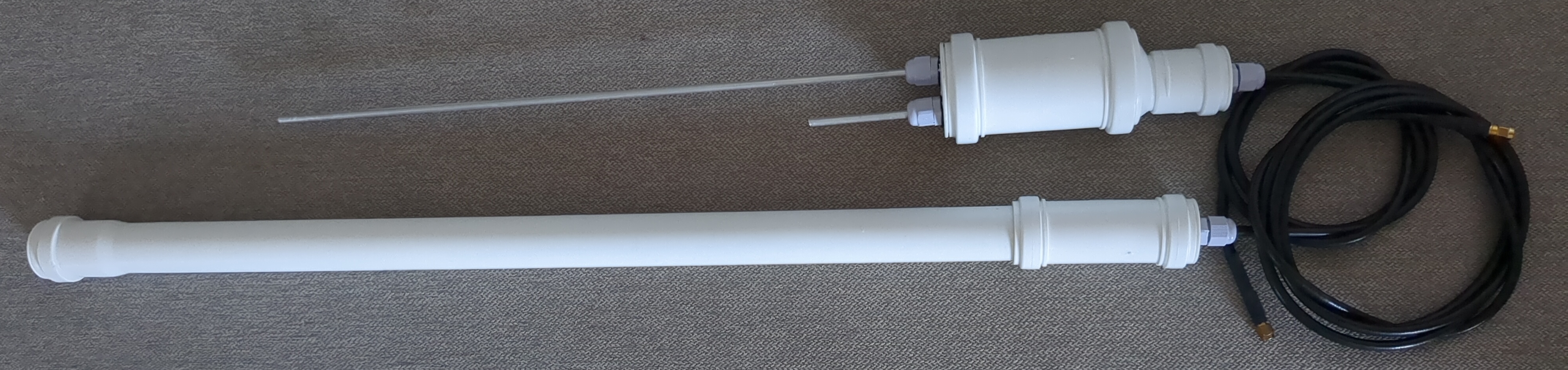
    for 70 cm, i’ve suggested jpole because it’s compact (long and thin), you can probably package it in 30mm or smaller plastic pipe, haul it around, pull out and mount it with a clamp on top of (not parallel to) metal mast and be good to go. you can have metal mast couple cm below shorting bar of jpole, or even a bit away and parallel to for a short run and it shouldn’t matter. if needed, radiating part can be mounted parallel to metal mast but needs to be a good distance away (halfwave away or more unless you want to tune it in place). with nonconductive mast the only conductor nearby is coax. it would be 50cm-ish long so good for mobile setup. these are fast and cheap, the way i’ve made them the most expensive part was plastic box, can be made and tuned with nanovna in a single evening

    groundplane antennas would be even shorter but much bulkier, unless you detach radials or mount them on a kind of swivel mount, and you have to put them in the air, as in, bottom end of radials can’t be too close to ground. mast considerations are pretty much as jpole, as in, the hub can be mounted on top of metal mast but not parallel and right next to it. if folded, 2m version would be about 50cm long, so it’ll probably make sense on 2m and down. you can probably make a 70cm band quarterwave whip attached to magnet so that you can put it on roof of your car, but it won’t be as good because height is might here, and jpole has center of radiation half wave above mounting point just because of the way it’s built. just that little bit of extra height might clear some obstructions. straight dipoles should also work, but they’re T-shaped unless disassembled, and you’ll have to run coax perpendicular to dipole for some length to avoid common mode current problems -> not as simple mechanically, fine for horizontal not so much for vertical

    you could also make a small (5-7 el? depends on how long do you want it) 70cm band yagi and store it on top of your radio box, but you’ll need to put it on a mast then rotate it, or hold it in your hand, preferably standing on a hill or something when in use. stiff jpole would be probably fine for 70cm, 2m if you can accommodate the length, lower than that, 2m to probably down to 6m or 10m, rollup jpoles should work okay as long as you have a way to deploy them. below that it’s probably mast + some kind of halfwave dipole territory (efhw? doublet? series of center fed dipoles? ocfd? some type of vertical? you decide)


  • antennas are on the more diy-able end of this activity, no need to buy them, make your own. firestik is a cb band (27mhz) antenna so you can’t use it anyway for this (your radio can’t transmit there either). you’ll need a way to measure your antenna, which means you need a tool like nanoVNA. for 70cm band, j-pole antenna will be easy to make and compact (50cm ish long) and would be either stiff (made from small diameter copper or aluminum pipe/wire) or elastic (so that it can be rolled up). if the former, put it all in a pvc water pipe sealed on both ends, with coax output going through a cable choke, or put the bottom section (from feedpoint to shorting bar) in some kind of plastic box, with wires also going through cable chokes. note that when tuning, pipe needs to be on antenna, because enclosure will shift resonant frequency down. you can mount the enclosure with metal clamp to something as long as clamp is below the shorting bar at the bottom. if latter, use twin lead for the parallel line section, or make your own because it can be hard to get (like this) aim for 300-450 ohm impedance. then you can roll up this antenna when not used and suspend it from a fishing rod (wood or fiberglass only) or from string attached to tree or something when you need to use it. in either case, do not connect shorting bar to coax shield and do put a ferrite bead or two on coax. do not deploy antenna directly next to conductive surface or rod. do not deploy antennas next to power lines. if you want to use 2m band, you’ll need separate, 3x longer antenna for it. there are slightly more complicated ones that get you both 2m and 70cm. there are many guides about this, but this is one of simplest ways to get it working

    that said, you’ve got a pretty capable, heavy and expensive radio here. if you just want to use 70cm, then you can get away with something much smaller and cheaper, you could hold it in your hand. like baofeng, or quansheng if you want to reflash it. 70cm (UHF and VHF in general) allows for contacts within line of sight only; put your antenna on a mast for more range. HF bands have different limitations, but range is not limited in this way (it’s limited in different way). there are many schools of thought on how to make it work best, but general shape of solution is either halfwave-ish long reel of wire (low tens of meters) that needs to be put high in the air, horizontally, either using trees or fiberglass mast as a support, or some kind of conductive mast (or nonconductive mast with wire going up along), about quarterwave long, with wires of similar length strewn on ground. there are many choices and tradeoffs depending on where you intend to transmit from (car? bike? some mobile setup with everything fitting in a backpack? shed in the woods? tent in the desert?), target bands (HF or VHF/UHF or maybe microwaves?) and how are these supposed to be used (CW? phone? digital modes? point to point contacts? through repeater? through satellite? bouncing signal from the moon?)


  • Yeah they’ll make medbeds any day now. Or maybe it’s for their internal use only, because they’ll noticed bubble and don’t like what they’re seeing. I wonder if they’re foolish enough to vacuum up all data from companies that used their chatbots to come up with something hoping that no one will notice

    Every single bit of that is so fucking stupid, they’re replaying crypto playbook 1:1. Spot an industry that they think they’ll manage in, then try to leech off of it in purest display of rentseeking imaginable, coupled with techbros folk belief that since programming is soo haard, then as they can do that they can do everything else too, all with no plan, no labs, no specialists onboard or faintiest idea what they’re doing


  • every week of work with biologists brings another “guess we doin circles now” moment. there’s simply so many things that were never measured, measuring them requires knowing what are you doing, proper experimental design and interpretation of results, that are affected by myriad factors and dozens of feedback loops. none of that is in training data of course, and even if it was it would help very little because humans measuring that would make better use of these results first. but don’t worry about that, machine god will learn relativity from three video frames and will make peter thiel immortal right away


  • fullsquare@awful.systemstohmmm@lemmy.worldhmmm
    link
    fedilink
    arrow-up
    3
    ·
    edit-2
    11 天前

    apparently it’s NFPA (american fire safety code) thing. these regulations might have been written when inhalational anesthetics were flammable. also keep in mind that people under anesthesia can’t move and that was also probably a factor


  • fullsquare@awful.systemstohmmm@lemmy.worldhmmm
    link
    fedilink
    arrow-up
    11
    ·
    edit-2
    11 天前

    maybe it is for power cord specifically, and the same type is used for hospital equipment. some of (modern) anesthetics are powerful solvents but not particularly flammable. maybe it also has something to do with potential extra oxygen (or nitrous oxide) content in air